

- ‘Visibility is not value’
- Business literacy
- Artificial intelligence
- NFVCB seeks responsive regulation
- Regulation and creative freedom
- Government’s position
- Markets, authenticity and monetisation
- READ ALSO: After 28 years, NFVCB secures permanent headquarters, pursues name change
- Insurance and film production
- Discover more from Premium Times Nigeria
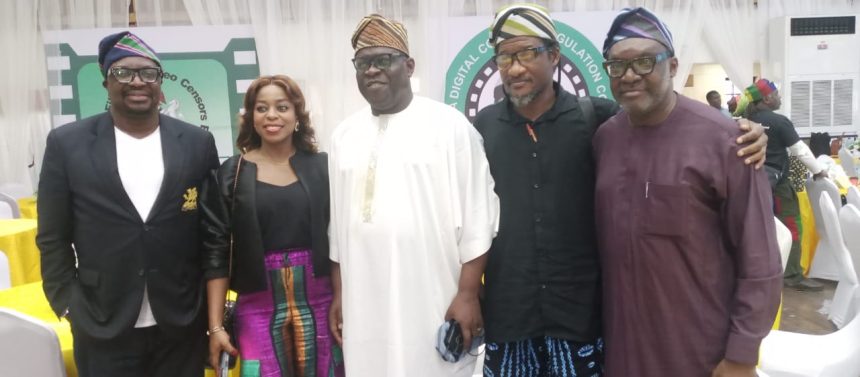
Persistent concerns about royalties, licensing, intellectual property ownership and creators’ compensation took centre stage at the sixth Peace Anyiam-Osigwe Nigeria Digital Content Regulatory Conference organised by the National Film and Video Censors Board (NFVCB).
The two-day conference, held on Wednesday and Thursday at the MUSON Centre in Lagos, examined how Nigerian filmmakers could derive more economic value from Nollywood’s growing global reach.
It had the theme, “Film and Content Production in the Digital Era: Balancing Regulation and Innovation,” and brought together filmmakers, regulators, distributors, streaming-platform representatives, technology specialists and investors.
Delivering the keynote address, veteran actor Richard Mofe-Damijo challenged Nollywood to confront persistent problems surrounding royalties, licensing, intellectual property and the compensation of creative professionals.
Mr Mofe-Damijo, popularly known as RMD, said the international popularity of Nigerian films would mean little if the economic value generated did not return to the actors, writers, directors and producers responsible for them.
‘Visibility is not value’
RMD said Nollywood must look beyond production figures, box-office headlines, online engagement and international visibility when measuring the industry’s success.

“Visibility is not the same as value,” he said.
According to him, Nigerian films being watched worldwide did not necessarily mean that the people who made them received their fair share of the resulting revenue.
 He raised questions about who owns the intellectual property behind productions, controls distribution rights, tracks royalties and determines the terms under which content is licensed across territories and digital platforms.
“We cannot continue to celebrate the global popularity of Nigerian content while leaving the creators without sustainable economic returns,” he said.
RMD maintained that these questions were central to Nollywood’s sustainability, not peripheral concerns.
He said digital distribution had expanded the market for Nigerian content but also introduced complications involving revenue transparency, ownership, licensing and the enforcement of intellectual-property rights.
The actor also identified piracy as a continuing threat to the commercial value of Nigerian productions and practitioners’ livelihoods.
He called for closer cooperation among regulators, law-enforcement agencies, digital platforms, rights holders and industry associations.
Business literacy
RMD urged filmmakers and other practitioners to understand the business behind content creation better.
He said talent without adequate knowledge of contracts, licensing, intellectual property and commercial rights could leave creators vulnerable to exploitation.
“The next generation of Nigerian filmmakers must understand that they are not simply making films. They are creating intellectual property, and intellectual property is an asset,” he said.
The actor urged young filmmakers not to mistake online attention for lasting accomplishment or sacrifice the economic value and integrity of their work for temporary visibility.
He advised them to study their craft, understand the business of filmmaking, respect intellectual property and build professional relationships.
Artificial intelligence
RMD also addressed the opportunities and risks associated with artificial intelligence in filmmaking.
He said AI could assist with script development, visual effects, animation, editing, translation and audience analysis while reducing some production costs.
However, he warned that the technology raised serious questions about authorship, consent, ownership, data protection and performers’ rights.
“What happens when an actor’s image or voice is replicated digitally without permission?” he asked.
He also questioned who should own AI-generated creative works and what protection existed for writers and artists whose works might be used to train artificial-intelligence systems.
RMD urged Nigeria to develop appropriate safeguards before such problems became widespread.
He said technological innovation should expand the possibilities of human creativity rather than diminish the value of performers and other creative professionals.
NFVCB seeks responsive regulation
In his welcome address, NFVCB Executive Director and Chief Executive Officer Shaibu Husseini said streaming platforms, social media and AI had transformed the production, distribution and consumption of audiovisual content.
Mr Husseini said the developments created new opportunities but also raised questions about authorship, ownership, consumer protection and the sustainability of creative businesses.
He called for a regulatory environment in which innovation and regulation reinforced each other rather than operated as opposing forces.
The NFVCB chief said the agency was modernising its regulatory processes, strengthening inter-agency collaboration and promoting media literacy.
He said a technical review committee was examining the board’s classification, exhibition and distribution guidelines to ensure they remained relevant to current industry realities.
Mr Husseini also said the board had begun discussions with Goethe University over a possible partnership to digitise and preserve its audiovisual classification archive, which dates to 1994.
He identified piracy, intellectual-property violations and the responsible use of AI as issues requiring coordinated action by government agencies and industry practitioners.
According to him, the NFVCB’s role is not to stifle creativity but to ensure that the industry develops responsibly while protecting creators, audiences and investors.
Regulation and creative freedom
RMD called for regulations that provide clarity and encourage innovation without unnecessarily restricting filmmakers.
He said regulators must understand the industry they supervise and remain responsive to technological changes affecting production and distribution.
According to him, effective regulation should protect audiences, build investors’ confidence and establish understandable standards for practitioners.
He cautioned, however, that responsible storytelling should not become an excuse to control storytelling or prevent filmmakers from addressing uncomfortable subjects.
RMD said classification, age-appropriate access, transparent procedures and clear content guidelines could protect vulnerable audiences without intimidating creators.
Government’s position
The Minister of Art, Culture, Tourism and the Creative Economy, Hannatu Musawa, said the government was working to transform Nigeria’s creative economy from a largely talent-driven sector into a structured, investment-ready and globally competitive industry.
Ms Musawa, represented by the Special Adviser to the President on Arts and Culture in the minister’s office, Moriam Ajaga, called for sustained cooperation among government agencies, filmmakers, investors and digital platforms.
She said the Creative Economy Development Fund was providing debt, equity and grant-funding opportunities for creative enterprises.
The minister also highlighted Nigeria’s audiovisual co-production engagements with countries including South Africa and France, saying such partnerships could promote knowledge exchange, investment, skills transfer and international distribution.
Markets, authenticity and monetisation
Speaking during a session on production standards, filmmaker and Zuri24 Media founder Femi Odugbemi described authenticity as one of Nollywood’s most significant competitive advantages.
Mr Odugbemi said filmmakers must pay closer attention to story development and understand the audiences their productions are intended for.
Film and television content distributor Ijeoma Onah also urged producers to understand the market before beginning production.
She advised filmmakers to engage market executives early and use international film festivals to build networks, secure partnerships and expose their work to wider audiences.
During a session on digital monetisation, Adetutu Laditan encouraged creators to diversify their revenue sources through advertising, sponsorships, branding and affiliate marketing.
She also urged them to develop content that retains its value and audience beyond the creator’s lifetime.
READ ALSO: After 28 years, NFVCB secures permanent headquarters, pursues name change
Insurance and film production
The conference also examined insurance’s role in professional filmmaking.
Rex Insurance Executive Director Sonny Owagboi urged producers to include insurance in their production planning and budgets.
Mr Owagboi, who represented the company’s chief executive, Ebelechukwu Nwachukwu, identified equipment, vehicles, drones, workplace injuries, and personal accidents as risks associated with film production.
He described insurance as a risk-management instrument that could protect investments, support business continuity and improve confidence among film investors.
The conference ended with a call for stronger collaboration among regulators, creative practitioners, investors and technology companies to build a more competitive and economically sustainable Nigerian film industry.
Discover more from Premium Times Nigeria
Subscribe to get the latest posts sent to your email.