


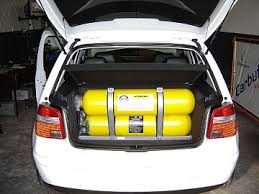
Some vehicles require specialised kits which cost between N600,000 and N2m to convert into Compressed Natural Gas (CNG), a technician has said.
Julius Yaama, Technical Process Manager at Rolling Energy, a CNG conversion centre in Jahi, Abuja, said vehicles with Gasoline Direct Injection (GDI) engines and some turbocharged engines could not use conventional sequential conversion kits.
He said such vehicles require special kits, adding that “the kits alone is almost over 2 million naira”, depending on availability.
Yaama spoke during a media tour of the facility on Thursday, organised by the Presidential Initiative on Compressed Natural Gas and Electric Vehicles (Pi-CNG & EV) to mark the United Nations World Sustainable Transport Day.
He said the cost of converting other eligible vehicles at the centre ranged from N600,000 for a 65-litre cylinder to N750,000 for a 75-litre cylinder.
Explaining the conversion process, Yaama said the installation involved adding components to a vehicle’s existing system to enable it to run on both petrol and CNG without tampering with its original manufacturer-installed components.
He explained that the system had a control unit that communicates with the vehicle’s computer, a pressure reducer, high- and low-pressure pipes, a refill valve and an injector rail.
According to him, the pressure reducer brings down the gas pressure from about 200 to 250 bar in the cylinder to approximately two psi before it is supplied to the engine.
Yaama said a vehicle must be mechanically sound before conversion, warning that the process would not correct existing engine problems.
“If your car is jerking, or the plugs are not good, or the coils are not good, whatever the car does, after conversion, the CNG will copy,” he said.
He said the centre conducts pre-inspection before accepting vehicles for conversion, adding that cars with faults are rejected until their owners fix them.
“We don’t just convert any car that comes in. We have to inspect the vehicle first. If there is any problem, the owner has to fix it before we can proceed,” he said.
Yaama also cautioned against converting old vehicles with weak engines, saying such vehicles might not deliver the expected performance.
He said the centre converted an average of three to four vehicles daily, while urging motorists to maintain their vehicles and conversion systems after installation.
He said CNG vehicles required suitable spark plugs, which could weaken after two to three months of use, while filters should be checked and cleaned every three to six months.
On the lifespan of the equipment, Yaama said CNG cylinders had a lifespan of 15 years from their production date and should not be used beyond that period.
He said the cylinders could be transferred to another vehicle, subject to the necessary workshop checks, while the conversion kits did not have a specified lifespan.
An estate surveyor and CNG user, Adeolu Bamidele, said the lower cost of gas remained a major attraction despite some inconveniences associated with its use.
He said long queues at refuelling stations could also discourage users, particularly when they encountered lines of between 150 and 200 vehicles.
“If you get to the station and you get a long queue of 150 to 200 vehicles, you will be scared. But if you are thinking of the end result, the cost you are going to save, you will not mind,” he said.
He added that the services at some refuelling stations had not met users’ expectations.
The Head of Brand and Communications at Pi-CNG & EV, Onyekachi Eke, said the media tour was designed to give journalists firsthand knowledge of the conversion process and enable them to address public concerns about CNG.
“We’ve been shouting that CNG is safe. CNG is safe. So this is an opportunity for you to ask all your questions, see how the process goes on,” she said.
Eke urged motorists to go to accredited conversion centres rather than roadside mechanics, stressing that proper installation was important to ensuring safety.
UPDATE NEWS:
Nigerians can now invest ₦2.5 million on premium domains and profit about ₦17-₦25 million. All earnings paid in US Dollars. Rather than wonder,
click here to find out how it works.