

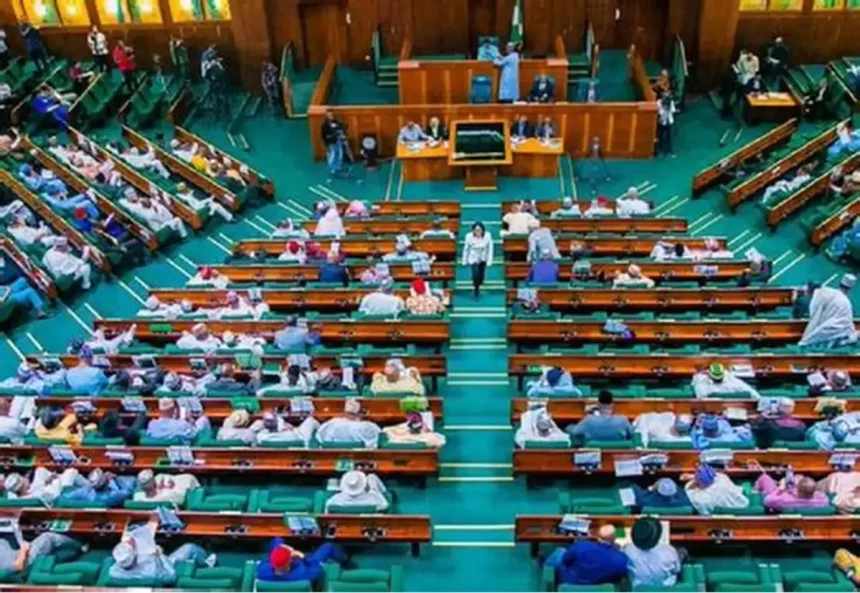
House of Representatives has adopted a bill which seeks to empower Central Bank of Nigeria (CBN) to impose sanctions, including administrative penalties and supervisory measures, on financial institutions that violate regulatory requirements, as well as compel the prompt return or orderly transfer of customers’ funds and critical payment operations where a licensed payment-service provider enters into severe distress, subject to applicable insolvency laws.
These provisions are contained in the report on the proposed Banks and Other Financial Institutions Act (BOFIA) Amendment Bill, 2026, adopted by the House during Wednesday plenary at the Committee of the Whole.
The proposed bill seeks to strengthen the apex bank’s regulatory powers over banks, fintech companies, digital payment platforms and other financial institutions operating in Nigeria.
ALSO READ: 2027: ACF expresses concerns over violent campaigns
According to the report obtained by Nigerian Tribune, the proposed legislation, among other things, seeks to address emerging risks associated with the rapid expansion of digital financial services, protect customers’ funds, strengthen financial stability, regulate systemically important institutions and establish clearer responsibilities among financial sector regulators.
Under the proposed new Section 69A(5), where a licensed payment-service provider enters into severe distress, CBN may, in consultation with the Nigeria Deposit Insurance Corporation (NDIC), where appropriate, require the prompt return or orderly transfer of safeguarded customer balances, customer records and critical payment functions to an eligible provider.
The bill further provides that money received or held by licensed institutions on behalf of payment-service users, other than deposits lawfully accepted by deposit-taking institutions, must be adequately safeguarded through appropriate segregation of customer funds, accurate records, daily reconciliation and restrictions against using such funds for the institutions’ own purposes.
The piece of legislation specifically provides that safeguarded customer funds shall be held in trust for payment-service users and shall not form part of the assets available to general creditors in the event of insolvency, liquidation or winding up.
However, the proposed amendment makes clear that the arrangement does not automatically extend deposit insurance coverage beyond the persons, accounts and limits provided under the NDIC Act.
The amendment also seeks to empower the CBN to designate licensed financial institutions as Systemically Important Institutions (SIIs) where their size, market share, number of users, transaction volumes or interconnectedness with banks and payment infrastructure could make their failure a threat to Nigeria’s financial stability.
Under the proposed new Section 62A, the CBN Governor would have the authority to designate such institutions and impose additional prudential, operational, governance and disclosure requirements considered necessary to safeguard the financial system.
The proposed Section 62C further requires designated institutions to comply with CBN directives, submit information and documentation for supervisory purposes, maintain appropriate governance, cybersecurity, technology-risk and operational-resilience standards, and notify the regulator of material changes capable of affecting their systemic importance.
Of particular significance is the proposed regulatory framework for foreign-controlled financial institutions. Under Section 62C(2), such institutions would be required to maintain adequate data-governance arrangements concerning Nigerian users, transactions and financial activities, including compliance with applicable Nigerian data-residency requirements.
The CBN would also be empowered to access systems, algorithms, models and data used in the Nigerian operations of designated institutions where reasonably required for supervisory purposes.
The proposed Section 62F reinforces this authority while providing safeguards for confidentiality, data protection, cybersecurity, legal professional privilege and commercially sensitive information.
To ensure compliance, the proposed Section 62G empowers the CBN to impose administrative penalties and supervisory measures on systemically important institutions that violate regulatory requirements. In determining the appropriate sanctions, the Bank would consider the seriousness and duration of the breach, its actual or potential implications for financial stability, previous violations, and remedial measures undertaken by the institution.
Affected institutions would ordinarily be given an opportunity to make representations before material penalties are imposed, except where immediate intervention is necessary to protect financial stability or customers.
The bill also introduces a framework for administrative review and judicial appeals. Under Section 62H, an institution dissatisfied with a CBN decision may request an administrative review within 30 days, while the Bank is expected to determine the application within another 30 days. Where the institution remains dissatisfied, it may appeal to the Federal High Court within 30 days of the decision or expiration of the review period.
In another significant provision, the proposed amendment to Section 70 prescribes a minimum fine of N10 million and an additional penalty of not less than N500,000 for every day an offence continues where a bank or other financial institution fails to comply with policy measures issued by the CBN.
Such measures include liquidity standards, stress-testing requirements, recovery and resolution plans, enhanced supervision and disclosure obligations.
The proposed legislation equally seeks to strengthen cooperation between the CBN and the Federal Competition and Consumer Protection Commission (FCCPC) by requiring both institutions to jointly develop and implement, within 12 months of commencement, a framework for coordinated regulation of consumer protection and competition matters in the financial sector. Under the proposed amended Section 30, the framework would provide for information sharing, joint investigations, coordinated enforcement, consumer education and mechanisms for resolving jurisdictional disputes, while preserving the CBN’s exclusive prudential supervisory authority over financial institutions.
Furthermore, the bill proposes the establishment of a Fintech and Innovation Coordinating Committee (FICC), chaired by the CBN Governor, with membership drawn from the Securities and Exchange Commission, Nigerian Communications Commission, National Information Technology Development Agency, FCCPC and Federal Ministry of Finance.
The FICC, which would meet at least quarterly, is expected to coordinate regulatory approaches to fintech, digital financial services, payment systems and emerging technologies without taking over the statutory licensing, supervisory or enforcement responsibilities of its constituent agencies.
Other significant provisions include enhanced CBN oversight of mergers and acquisitions involving financial institutions, with the CBN assessing prudential and financial stability implications and the FCCPC examining competition and consumer protection concerns. Under the proposed Section 65, both regulators would endeavour to complete their respective assessments within 60 days of receiving complete applications.
The amendment also introduces provisions on market concentration, critical third-party technology services, disclosure of ultimate beneficial ownership, foreign control, group-wide financial supervision and possible structural separation of institutions where necessary to address documented systemic risks.
WATCH TOP VIDEOS FROM NIGERIAN TRIBUNE TV