


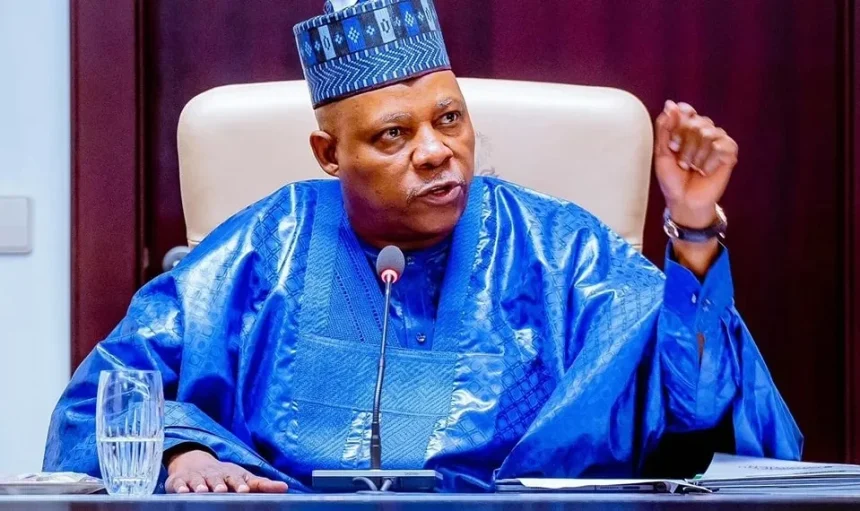
Vice-President Kashim Shettima has said the late former President Muhammadu Buhari’s modest lifestyle and restraint from worldly possessions demonstrated the true essence of leadership, stressing that the character of a leader matters more than the power and privileges attached to public office.
Shettima said Buhari’s spartan lifestyle distinguished him in Nigeria’s political history, describing him as a leader who wielded enormous authority but remained uninterested in material possessions.
The Vice-President stated this on Thursday at the public presentation of Muhammadu Buhari: The Authorised Biography, a three-volume publication, held at the Nigerian Army Conference Centre and Suites, Abuja.
ALSO READ: Railway reforms: Reps seek 60-day investment, private partnership plan
Shettima, who was represented by the Special Adviser to the President on General Duties in the Office of the Vice-President, Dr Aliyu Modibbo Umar, said Buhari’s life and leadership offered enduring lessons for present and future generations.
According to him, the former President demonstrated that the dignity of public office depended largely on the personal character of its occupant.
“His Spartan lifestyle distinguished him in a world where too many seek public office to satisfy private appetites. There was something arresting about a man who could command so much and desire so little,” he said.
Reflecting on his relationship with the late President, Shettima said he learnt valuable lessons from Buhari, particularly his patriotism, simplicity and commitment to national service.
“I learnt so much from President Buhari as a leader, as a human being who was not drawn to worldly possessions, and as a patriot whose devotion to Nigeria endured beyond the offices he held.
“He taught me that the dignity of office depends upon the character of its occupant. He also taught me that a leader’s example continues to speak long after he is out of service,” he added.
The Vice-President said public officeholders had a responsibility to leave behind records of service and legacies capable of inspiring future generations, noting that those who failed to tell their stories risked having others define their contributions.
He described Buhari as a political phenomenon whose career defied conventional expectations, adding that his popularity among Nigerians reflected public recognition of his distinctive personality and approach to leadership.
Shettima commended the author, Dr Udu Yakubu, and May Publishing Limited for documenting Buhari’s life, saying the three-volume work would provide future generations with valuable materials to understand the former President, his leadership and his place in Nigeria’s history.
He also acknowledged the contributions of Buhari’s family, friends and associates to the preservation of his legacy, while praying that Almighty Allah would forgive his shortcomings and grant him eternal rest.
Earlier, former President of Niger Republic, Mahamadou Issoufou, who chaired the occasion, described Buhari as one of the best-known African leaders of his generation and a statesman whose influence extended beyond Nigeria.
Issoufou, who said he attended the event both as a personal friend of Buhari and a former Head of State, recalled the close historical, cultural and geographical ties between Nigeria and Niger, noting that the late President understood the importance of strengthening relations between the two countries.
He said Buhari made his first diplomatic visit to Niger on June 3, 2015, less than a week after his inauguration as Nigeria’s President, accompanied by governors from five states.
According to him, Buhari’s decision to prioritise relations with neighbouring countries reflected his understanding of Nigeria’s geographical realities and the importance of regional cooperation.
Issoufou recalled their collaboration on regional security, particularly efforts to combat terrorism in the Lake Chad Basin and the Sahel, saying Buhari was unwavering in his determination to defeat Boko Haram and supported the Multinational Joint Task Force.
He also described Buhari as a leader with a clear vision for Nigeria, West Africa and the African continent, anchored on peace, unity, stability, sovereignty and prosperity.
The former Nigerian President identified prudence, moderation, patience, persistence and a strong sense of duty as some of Buhari’s defining leadership qualities.
He said the late President respected constitutional order, particularly the principle of term limits, and facilitated the democratic transfer of power.
On the biography, Issoufou said the three-volume publication was significant because it went beyond documenting Buhari’s achievements to examine the circumstances surrounding his decisions, the challenges he faced, the choices available to him and the consequences of his actions.
He stressed that historical assessment required evidence, objectivity and time, adding that future generations should be able to examine Buhari’s life beyond political slogans, partisan interpretations and immediate emotions.
“History requires more than the narration of such a journey. It requires evidence. It requires distance. It requires time,” he said.
Issoufou noted that Buhari’s political journey, from his emergence as a military Head of State in the 1980s through imprisonment, repeated electoral contests and eventual victory in the 2015 presidential election, constituted an extraordinary political trajectory.
He, however, acknowledged that Buhari, like other major political figures, was associated with controversies and decisions that would continue to attract historical scrutiny.
He congratulated Yakubu and May Publishing Limited for undertaking the project, describing the publication as a valuable contribution to Nigeria’s historical record.
In his remarks, the author, Dr Udu Yakubu, said the biography was the product of more than two and a half years of research, interviews, archival investigations and extensive engagement with people who knew the late President.
He said Buhari personally authorised the project and participated in the research while alive, granting him access to conduct interviews and seek clarifications on events spanning several decades.
Yakubu also acknowledged the contributions of Buhari’s nephew, Mamman Daura, whom he described as instrumental in providing historical context, clarifying events and helping him understand different phases of the former President’s life.
He said the biography was designed to withstand scrutiny and provide readers, researchers and future generations with an evidence-based account of Buhari’s life and leadership.
The author said the responsibility for assessing the work now rested with reviewers, scholars and readers, adding that a biography of such magnitude should not seek protection from criticism but should stand on the strength of its evidence and integrity.
WATCH TOP VIDEOS FROM NIGERIAN TRIBUNE TV