


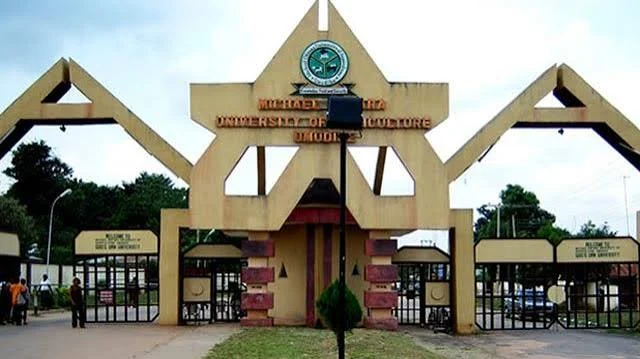
The Federal Government has inaugurated a 3MW solar hybrid power plant at Michael Okpara University of Agriculture, Umudike, Abia State, providing students and staff with a steady source of electricity.
The plant, according to a statement by the Energising Education Programme under the Rural Electrification Agency on Sunday, comprises a rehabilitated distribution network and a renewable energy training centre. It is the third project delivered under Phase II of the Energising Education Programme.
It will power teaching, learning, research and administration across the university and boost its work in agricultural research, innovation, food processing and practical training, while reducing its reliance on conventional energy sources.
The Minister of Power, Joseph Tegbe, inaugurated the plant, while the Abia State Commissioner for Power and Public Utilities, Ikechukwu Monday, represented Governor Alex Otti at the ceremony, which was attended by senior government officials, university management and development partners.
According to the statement, Tegbe said a steady power supply would attract businesses to the campus and create new sources of income for the university.
“With this plant running, very soon you will have new tenants on this university’s premises. Businesses will come because you have 24/7 power, and it is even cheaper.
“I expect business to grow here, and it will be an opportunity for the university to make more money and make the lives of our students more comfortable,” the minister said.
He described the project as part of President Bola Tinubu’s Renewed Hope Agenda to expand electricity access, strengthen educational institutions and grow the economy. He added that the Electricity Act 2023 opened up the power sector to states and private investors.
“I believe that very soon, with the continued support of President Bola Ahmed Tinubu, we will solve Nigeria’s electricity problem,” he said.
The Managing Director and Chief Executive Officer of the Rural Electrification Agency, Abba Aliyu, said the plant would drive agricultural research, innovation, entrepreneurship and job creation.
“Beyond these impressive engineering numbers, we are commissioning infrastructure of possibilities: uninterrupted research, advanced agricultural innovation, extended learning hours and the emergence of a new generation of entrepreneurs in Aba,” Aliyu said.
He urged the university community to turn the investment into practical innovations, commercialised research and new businesses.
He also charged the institution to sustain the facility through the Renewable Asset Management Company framework, which provides professional operations and maintenance services.
Under Phase II, the EEP has so far provided electricity to seven federal universities and two affiliated teaching hospitals, with an installed capacity of about 32MW.
The projects serve 202,983 students, 23,088 academic and non-academic staff and about 5,500 healthcare workers.
The programme has also trained 140 female STEM students and 700 other students in renewable energy.
Phase II involves the construction of captive solar hybrid power plants, rehabilitation of distribution networks, installation of solar streetlights, establishment of renewable energy training centres and training for female STEM students.
The REA implements the EEP for the Federal Government through the Nigeria Electrification Project, with support from the World Bank and the African Development Bank.
The programme aims to provide reliable and sustainable electricity to 37 federal universities and seven affiliated teaching hospitals across Nigeria.