


*81 companies fail to pay *As earnings hit N9.29trn *MTN, Dangote Cement, BUA Foods, GTBank, Zenith, others dominate payout *Shareholders get cash, companies retain N5.18trn for growth *Analysts warn: High dividend payout could constrain expansion if earnings weaken
By Peter Egwuatu
For thousands of investors who put their money into the Nigerian stock market, the real reward from owning shares is often not the daily movement in stock prices, but the cash that eventually lands in their accounts.
That reward amounted to a staggering N4.11 trillion for shareholders of 65companies quoted on the Nigerian Exchange Limited (NGX), as the companies paid out the sum as dividends from combined net income of N9.29 trillion in the financial year 2025, amid the ongoing economic reforms of the Federal Government.
The dividend payout comes against the backdrop of wide-ranging economic reforms by the Federal Government, including the removal of the petrol subsidy, exchange-rate reforms and measures aimed at improving government revenue, investment and the business environment.
Against this backdrop, dividend payments have become particularly significant for investors seeking to preserve returns and generate income amid persistent economic pressures.
The dividend declared means that the companies distributed about 44.2 per cent of their combined earnings to shareholders, leaving approximately N5.18 trillion, or 55.8 per cent, within the businesses.
For shareholders, the numbers represent a major income stream at a time when investors are increasingly looking for reliable returns from the capital market.
Vanguard’s latest findings show that, out of the 146 listed companies, 81 companies did not declare dividends to their shareholders.
But behind the dividend bonanza lies a bigger concern for the companies and the Nigerian economy: how much should businesses distribute today and how much should they retain to finance tomorrow’s growth?
MTN, Dangote Cemen, BUA Foods lead N4.11trn payout
The dividend distribution was heavily driven by some of the country’s biggest and most profitable listed companies.
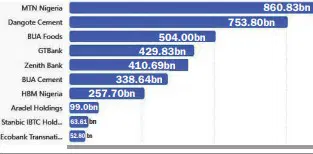
MTN Nigeria topped the table with N860.83 billion in dividend payments, followed by Dangote Cement with N753.80 billion.
BUA Foods paid N504 billion, while Guaranty Trust Bank (GTBank) and Zenith Bank paid N429.83 billion and N410.69 billion, respectively.
BUA Cement distributed N338.64 billion, while HBM Nigeria paid N257.70 billion.
The other three companies that made the top 10 were Aradel Holdings, N99.0 billion; Stanbic IBTC Holdings, N63.61 billion; and Ecobank Transnational Incorporated, N52.80 billion.
The scale of the payouts shows the growing importance of large listed companies to investors who depend on dividend income.
For a retail investor holding shares directly, the dividend represents cash income. For pension funds and other institutional investors, dividends form part of the returns generated for millions of beneficiaries and clients.
Top 10 low-paying dividend companies
Vanguard’s analysis of the top 10 low-paying dividend companies shows that Industrial & Medical Gases Nigeria led the pack, recording N365.5 million, followed by Learn Africa with N303.758 million.
Chams Holding Company occupied the third position, posting N270.0 million. Meyer Plc recorded N223.977 million, followed by UPDC Plc with N185.671 million.
ABC Transport occupied the sixth position, while Academy Press followed, recording N90.7 million.
Other companies with low dividend payments included McNichols, recording N78.24 million; University Press, posting N77.65 million; and Multiverse Mining Exploration, recording N63.92 million.
Investors: Cash today versus value tomorrow
Analysts said the N4.11 trillion dividend payout could strengthen confidence in stocks because it demonstrates that listed companies are not merely vehicles for capital appreciation but also sources of regular income.
An investment analyst said: “Dividends provide tangible returns to shareholders. Investors can use the income for consumption, reinvest it in other securities or add it to their existing holdings.”
However, the analyst cautioned investors against judging companies simply by the size of their dividend.
“What matters is whether the dividend is supported by recurring earnings and adequate cash flow. A very high dividend from a company whose earnings are weakening may not be sustainable,” the analyst said.
This is particularly important because shareholders ultimately benefit from both current income and the future value of their investments.
Where a company retains adequate earnings and invests them profitably, shareholders could benefit from higher future earnings and potentially larger dividends. Conversely, excessive retention without productive deployment of funds could limit shareholder returns.
Companies retain N5.18trn for expansion
The other side of the dividend is the N5.18 trillion retained by the companies.
Analysts said the money could provide an important source of internally generated capital for businesses seeking to expand production, acquire technology, strengthen working capital, reduce debt or finance new projects.
The advantage is that companies can undertake such investments without relying entirely on bank loans or fresh equity injections.
The analyst said: “Retained earnings are one of the cheapest sources of corporate funding. If management can deploy them into projects that generate returns above the cost of capital, shareholders ultimately benefit.”
High payouts raise sustainability concerns
The data also show significant differences in the proportion of earnings distributed by the companies.
For instance, BUA Foods paid dividends equivalent to about 93.1 per cent of its net income, while Dangote Cement and BUA Cement paid about 66.7 per cent and 67.7 per cent, respectively.
MTN Nigeria’s dividend payout was about 61.1 per cent, while GTBank’s stood at approximately 52.4 per cent.
Analysts said a high payout ratio is not necessarily a weakness because mature companies with strong cash flows may have fewer immediate investment needs.
But for companies operating in capital-intensive sectors or those with significant expansion plans, retaining a larger proportion of earnings could provide greater financial flexibility.
However, the analyst warned that retaining money simply for the sake of retaining it does not necessarily create value.
“Investors will want to know what management is doing with retained earnings. If the company has profitable investment opportunities, retention makes sense. But if there are no attractive projects, shareholders may prefer a greater portion of the earnings to be distributed,” the analyst added.
Commenting on the implications of dividend payouts and retained earnings, David Adonri, Managing Director of High Cap Securities Plc, said: “ Beyond individual investors and companies, the N4. 11 trillion dividend payment has implications for the wider Nigerian economy.
Dividends can stimulate economic activity when shareholders spend the income or reinvest it in other assets.
Institutional investors can also deploy dividend proceeds into other companies, government securities and other investments, thereby creating another channel through which corporate earnings circulate within the financial system.
He further said: “Money paid out as dividends is money that companies cannot simultaneously deploy to build new factories, increase production capacity, purchase machinery, develop technology or expand their workforce.
“Nigeria needs companies that are profitable enough to pay dividends and strong enough to continue investing. The objective should not be dividend maximisation alone, but sustainable corporate growth.
In fact, the overall figures underscore the growing role of the NGX in wealth distribution while highlighting the need for companies to strike a sustainable balance between dividend payments, retained earnings, capital investment and long-term growth.”
Speaking as well, Clifford Egbomeade, economic and communications expert, said: “ Stronger corporate investment could generate wider economic benefits through employment creation, increased production, tax revenues and development of local supply chains.
Another feature of the data is the concentration of dividend payments among a relatively small number of companies.
MTN Nigeria, Dangote Cement, BUA Foods, GTBank, Zenith Bank, BUA Cement and HBM Nigeria account for a substantial share of the total N4.11trillion distributed.
This means that a significant proportion of dividend income available to investors is being generated by a relatively small group of large and profitable companies.
The development underscores the importance of broadening the pool of profitable listed companies on the NGX.
A wider base of dividend-paying companies would give investors more choices and reduce dependence on a relatively small number of large corporations for equity income.”
On the N4.11 trillion dividend payout, he said: “It represents money flowing from corporate balance sheets into the hands of shareholders, while the N5.18 trillion retained represents potential funding for the next phase of corporate expansion.
“For investors, the immediate attraction is the cash return. For companies, the challenge is ensuring that retained earnings generate sufficient returns to justify keeping them within the business.
“For the Nigerian economy, the balance is equally important: dividends can deepen household and institutional income, while corporate reinvestment can create jobs, expand production and strengthen economic capacity.
“The performance of the 65 companies therefore highlights a fundamental capital-market equation reward shareholders today, but retain enough earnings to build the businesses that will generate tomorrow’s dividends.”