

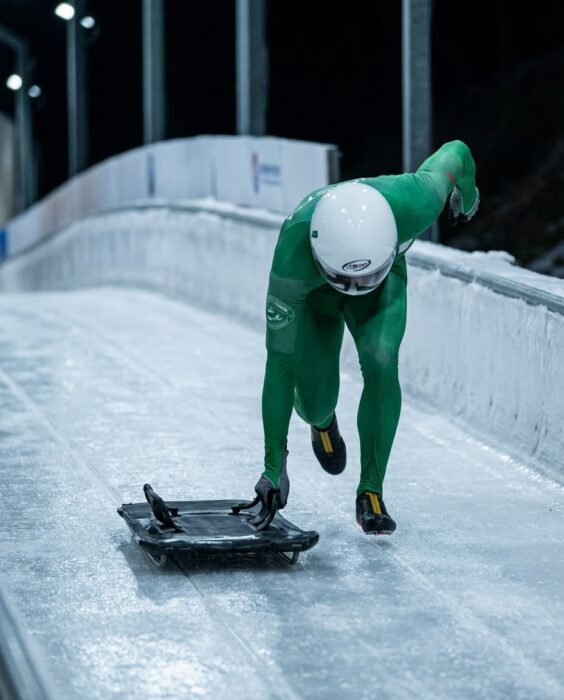
Nigerian skeleton athlete Yinka Oyebanjo-Odofin says he has spent about $30,000 of his personal funds pursuing his Winter Olympics dream, lamenting the lack of financial support and allowances from the government despite representing the country at international competitions.
Oyebanjo-Odofin, who is competing in the International Bobsleigh and Skeleton Federation (IBSF) circuit as he works towards qualifying for the 2030 Winter Olympics, said the financial burden of competing in the expensive winter sport had largely been left to him.
The athlete disclosed that he personally spent approximately $30,000 during his debut season last year, covering training, travel, accommodation, equipment and other competition-related expenses.
He said the financial demands had continued to rise, with his projected budget for the current season exceeding $49,000. However, he has so far raised only about 12 per cent of the amount.
Oyebanjo-Odofin lamented that, despite the sacrifices involved in competing internationally for Nigeria, he had not received government allowances to support his participation.
He explained that the cost of training alone was a major challenge, with each run costing about $50. The expense sometimes forces him to reduce the number of runs he completes during training sessions, even when additional practice is necessary to improve his performance.
The cost of essential equipment also adds to the financial pressure. He said a helmet could cost more than $500, while specialised shoes could approach $1,000, with the quality and aerodynamic features of equipment playing an important role in the sport.
Beyond equipment, the athlete must also meet expenses for coaching, accommodation, transportation and access to training facilities across different countries.
He said the financial challenges were affecting his ability to prepare adequately for competitions, stressing that athletes in winter sports require sustained investment to remain competitive.
Despite the difficulties, Oyebanjo-Odofin remains determined to improve his international standing. His immediate target is to break into the top 70, a position he believes would improve his chances of gaining access to higher-level World Cup and World Championship competitions in the following season.
His long-term ambition is to qualify for the 2030 Winter Olympics and make history for Nigeria in the sport.
During his 2025/26 debut season, he competed in 11 races across Whistler, Lake Placid, PyeongChang, Igls, Winterberg and St Moritz. He also set six Nigerian men’s track records, finishing 94th overall with 94 points and emerging as the second-highest-ranked male athlete representing an African nation.
Oyebanjo-Odofin’s experience highlights the financial difficulties confronting Nigerian athletes in winter sports, where access to specialised facilities, equipment and international competitions comes at a significant cost.
He also acknowledged the example of Nigerian winter sports pioneer Simidele Adeagbo, who invested considerable personal resources in pursuing her own Olympic ambitions.
For Oyebanjo-Odofin, however, the challenge is not simply reaching the starting line at international competitions, but finding the financial support needed to train consistently, compete effectively and sustain his pursuit of a place at the 2030 Winter Olympics.
We’ve got the edge. Get real-time reports, breaking scoops, and exclusive angles delivered straight to your phone. Don’t settle for stale news. Join LEADERSHIP NEWS on WhatsApp for 24/7 updates →