

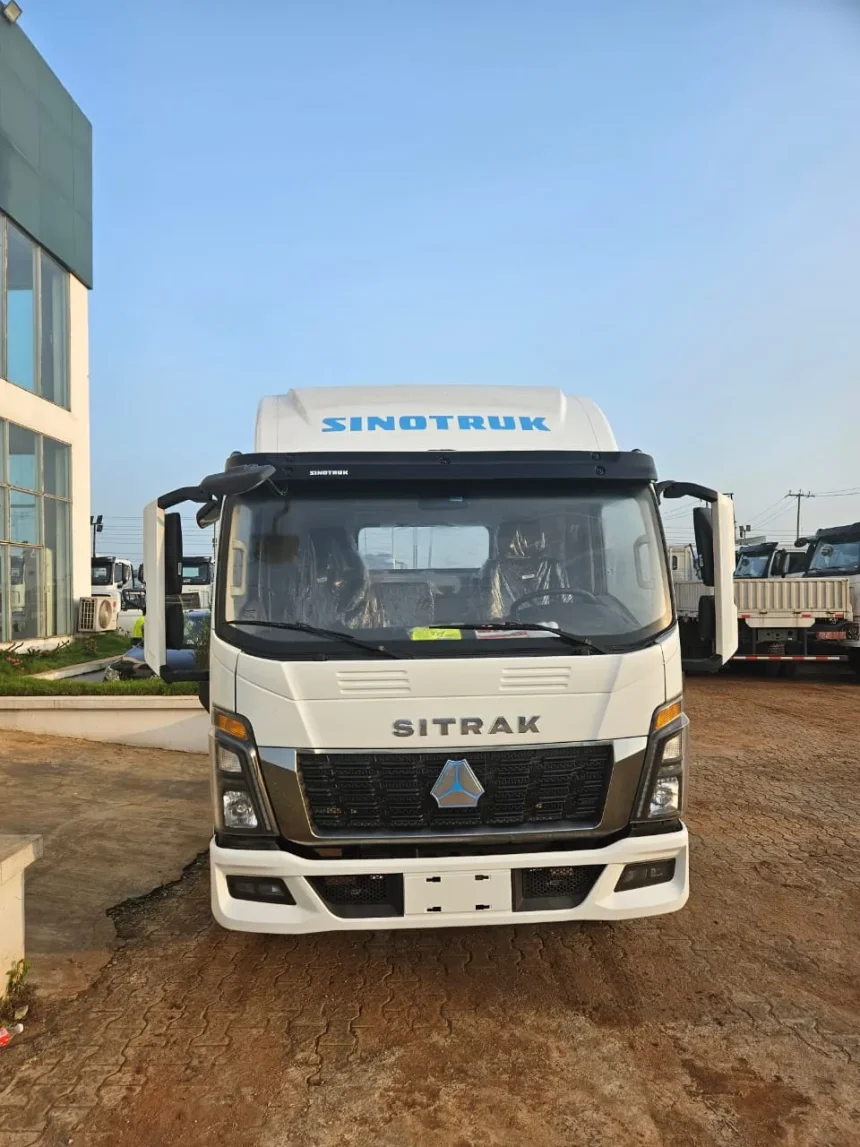
Nigerian Sinotrucks Limited has introduced Sitrak electric commercial trucks into the Nigerian market, targeting businesses seeking to reduce haulage costs, improve distribution efficiency and adopt cleaner energy alternatives.
The company, a Federal Government-recognised vehicle assembler and distributor of China’s Sinotruk brand, said the introduction of the electric trucks was part of efforts to provide businesses with lower-cost transportation options amid rising fuel prices and logistics expenses.
Speaking at the launch, the company’s founder and Managing Director, Alfred Okugbeni, said electric mobility could help address the high cost of transporting goods, which he identified as a major contributor to business expenses and consumer prices.
“The need to crack this has become imperative. And one of the major ways to crack this is to bring in low-cost operating vehicles. The electric truck fits very well into that,” Okugbeni said.
He explained that transportation costs remained a major cost driver for businesses, adding that reducing them could help ease inflationary pressures and improve competitiveness.
“We are looking at tackling major issues like inflation. Transportation cost is a major cost driver for businesses,” he said.
According to Okugbeni, the company expects electric trucks to deliver operating cost savings of between 40 and 50 per cent compared with conventional alternatives, depending on electricity costs, vehicle utilisation, charging infrastructure and maintenance requirements.
He said the company had previously introduced compressed natural gas (CNG) trucks, which had helped customers reduce fuel expenses by between 30 and 35 per cent.
“Moving to electric vehicles, there is further cost savings of nothing less than 40–50 per cent,” he said.
He added that electric mobility could also help operators address challenges associated with fuel theft, the use of inferior fuel and vehicle damage.
Nigerian Sinotrucks is initially targeting fast-moving consumer goods (FMCG) manufacturers and distributors, whose businesses depend heavily on regular movement of products between factories, warehouses, distribution centres and retail outlets.
Okugbeni said such businesses were well positioned to adopt electric trucks because many manufacturing facilities have excess electricity capacity during the night, allowing vehicles to be charged before deployment for daytime deliveries.
“Our target are the fast-moving consumer goods manufacturing people because they have excess energy through the night. So, they can easily charge up,” he said.
He acknowledged that inadequate electricity supply and limited public charging infrastructure remained challenges to the adoption of electric vehicles in Nigeria. However, he expressed optimism that investments in charging facilities would support market expansion.
“Charging stations are being built. But for commercial vehicles, the trucks, it is even a lot easier because they are working with factories that have excess energy,” he said.
According to Okugbeni, the light trucks can cover up to 200 kilometres daily, making them suitable for selected urban delivery operations.
On after-sales support, he said the company operates service hubs in Lagos, Kano, Benin, Abuja, Port Harcourt, Ibadan and Ogun State.
It also has a training centre in Ogun State, where drivers and technicians receive training, while its pickup vehicles are deployed as mobile service units to improve customer support.
“We have a training centre in our facility in Ogun State, where we train customers. Not just the technicians, we also train their drivers,” he said.
Okugbeni, however, said diesel, CNG and electric vehicles would continue to serve different segments of Nigeria’s commercial transport market, depending on operators’ routes, energy access and operational requirements.
He advocated a diversified fleet strategy, urging businesses to gradually introduce electric vehicles while retaining other vehicle types to ensure operational reliability.
Beyond the introduction of electric trucks, the company said it was committed to strengthening Nigeria’s automotive industry through vehicle assembly, technical training and local component development.
Okugbeni said the company would consider establishing full-scale assembly plants when the policy environment becomes favourable.
“We tend to, when the policy environment is right, build really full assembly plants. And we begin to look at a way to develop local components to minimise importation,” he said.
He identified 30 to 40 per cent local input as a key target for the Nigerian automotive industry, stressing the need to develop domestic suppliers, revive the steel industry and expand technical capacity.
He said stronger local manufacturing would reduce import dependence and position Nigeria to serve other African markets under the African Continental Free Trade Area framework.
UPDATE NEWS:
Nigerians can now invest ₦2.5 million on premium domains and profit about ₦17-₦25 million. All earnings paid in US Dollars. Rather than wonder,
click here to find out how it works.